
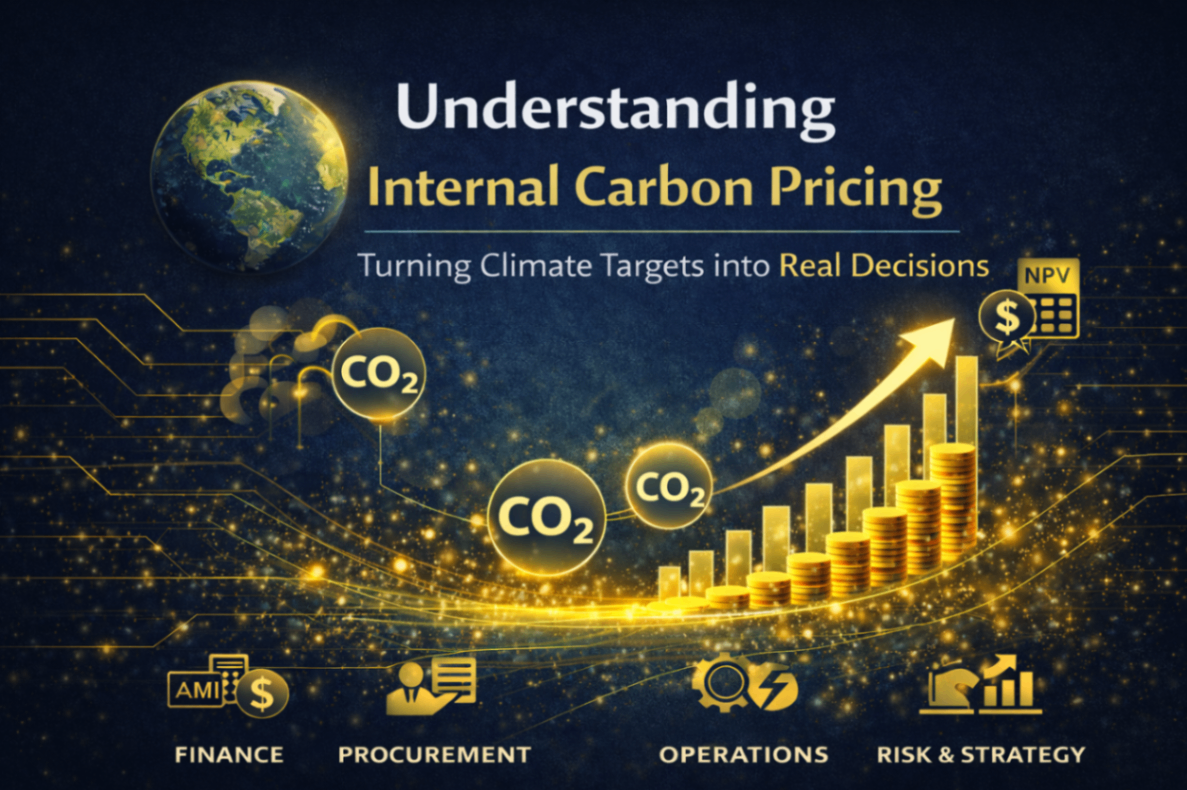
Across sectors, companies are setting ambitious climate targets- yet many struggle to convert these targets into real decisions. With global greenhouse gas emissions reaching a record 53.2 gigatonnes of CO₂ equivalent in 2024 and atmospheric concentrations crossing 422 ppm- 50% above pre-industrial levels- the pressure to act has never been greater.
The missing link is often economic visibility: carbon costs still don’t appear in annual accounts or internal financial statements.
Internal Carbon Pricing (ICP) bridges that gap. It places a monetary value on emissions, turning carbon from an environmental metric to an economic signal, a business signal. When emissions have a cost, low-carbon choices start making financial sense.
What Is Internal Carbon Pricing?
ICP is the monetary value that a company puts on its own carbon emissions, for example, $25 per tonne of CO₂. Even if there’s no external carbon tax, the company treats emissions as a real (internal) cost in its budgets and takes decisions accordingly. This encourages teams to reduce emissions because they directly affect project and investment costs.
ICP helps companies close that gap voluntarily, ahead of regulation. So how can companies price their carbon?
The Three Common Models of Internal Carbon Pricing
Internal Carbon Pricing is not a one-size-fits-all tool. Most organisations adopt it in stages, as their climate governance and data maturity improve.
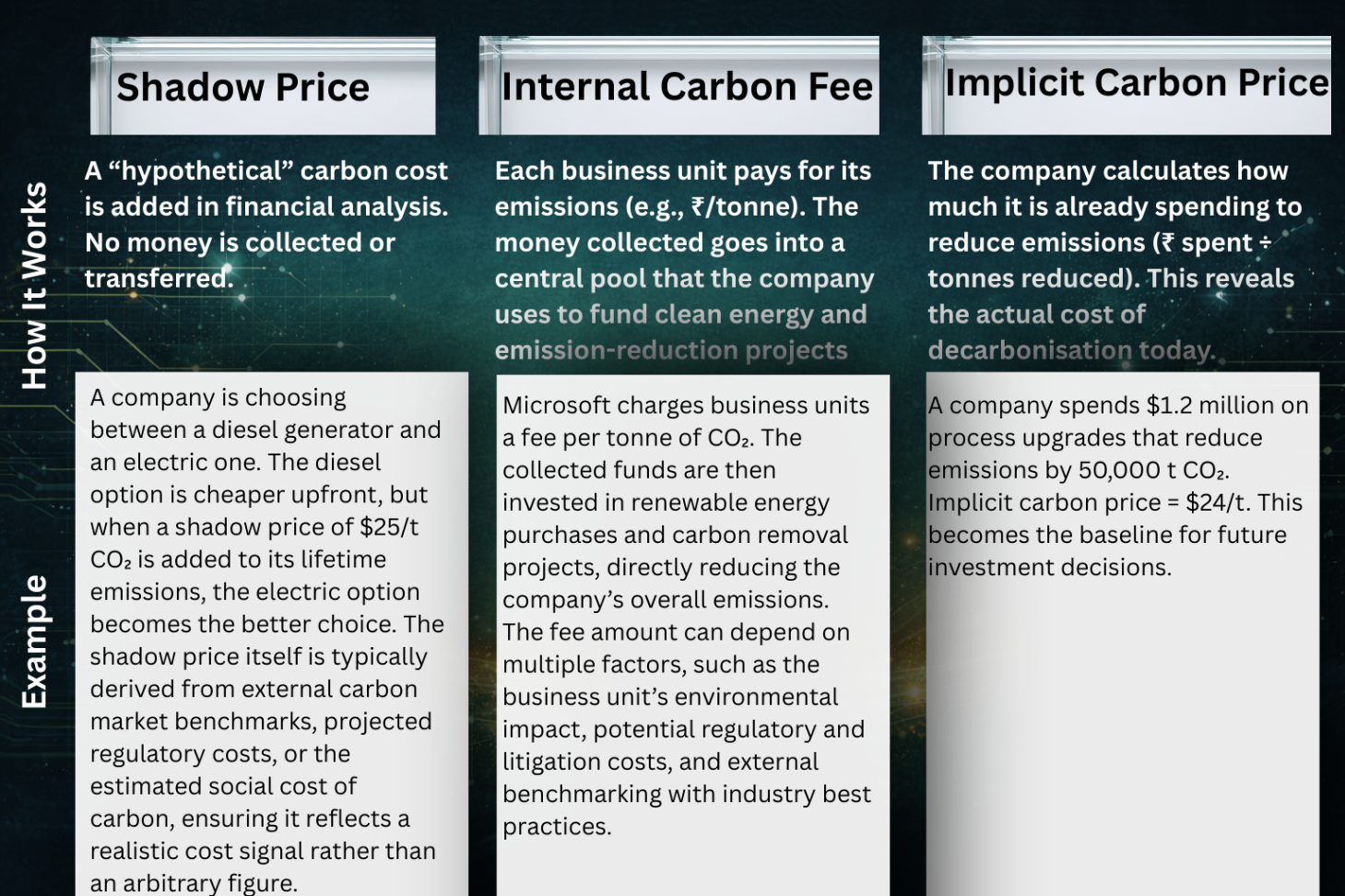
Once derived, the company needs to decide how and where to apply this pricing. It is worth noting that calculating the right carbon price requires careful analysis that may differ from industry to industry. These calculations often need large amounts of data, modelled carefully by domain experts.
Where to Apply Internal Carbon Pricing
To make real impact, ICP must appear in decision points, not just sustainability reports.
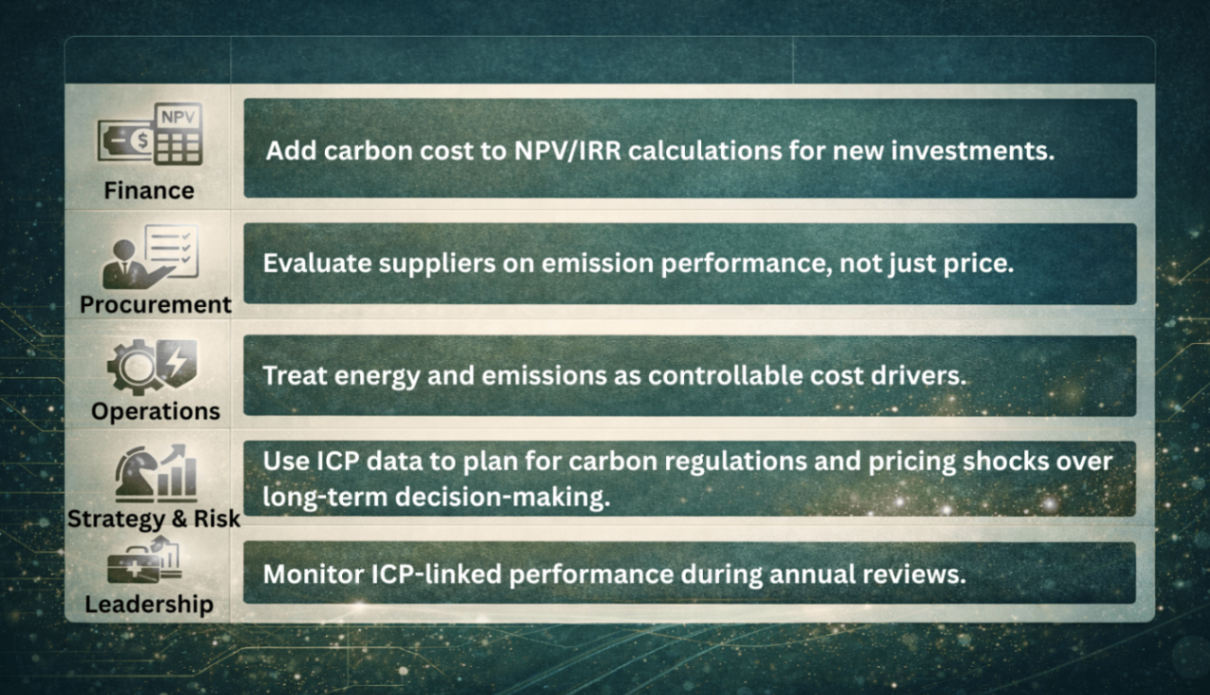
When carbon is visible across business functions, emission reduction becomes a natural outcome rather than a standalone effort. Internal carbon pricing helps companies begin closing that gap, turning carbon from an abstract metric into a real business cost, enabling better climate decisions, and building resilience against the regulatory landscape ahead. How to implement ICP and choose the right model will be explored in the next insight.