
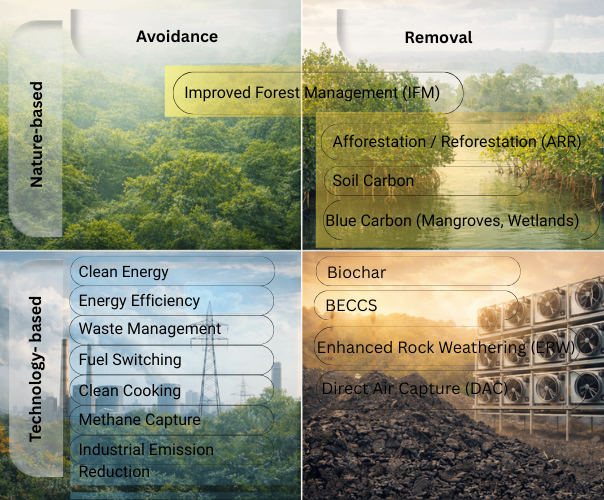
There are many ways to categorise carbon projects. Here, we use two simple lenses to explain how these projects operate and the type of climate impact they deliver.
What the project delivers: Avoidance vs. Removal
Avoidance projects reduce emissions by preventing greenhouse gases from being released into the atmosphere.
Removal projects extract CO₂ from the atmosphere and store it in biological or engineered reservoirs for a defined period.
How the project operates: Nature-based vs. Technology-based
Nature-based solutions (NBS) rely on natural ecosystems and biological processes to reduce or remove greenhouse gas emissions.
Technology-based solutions use engineered systems and industrial processes to deliver emission reductions or removals.
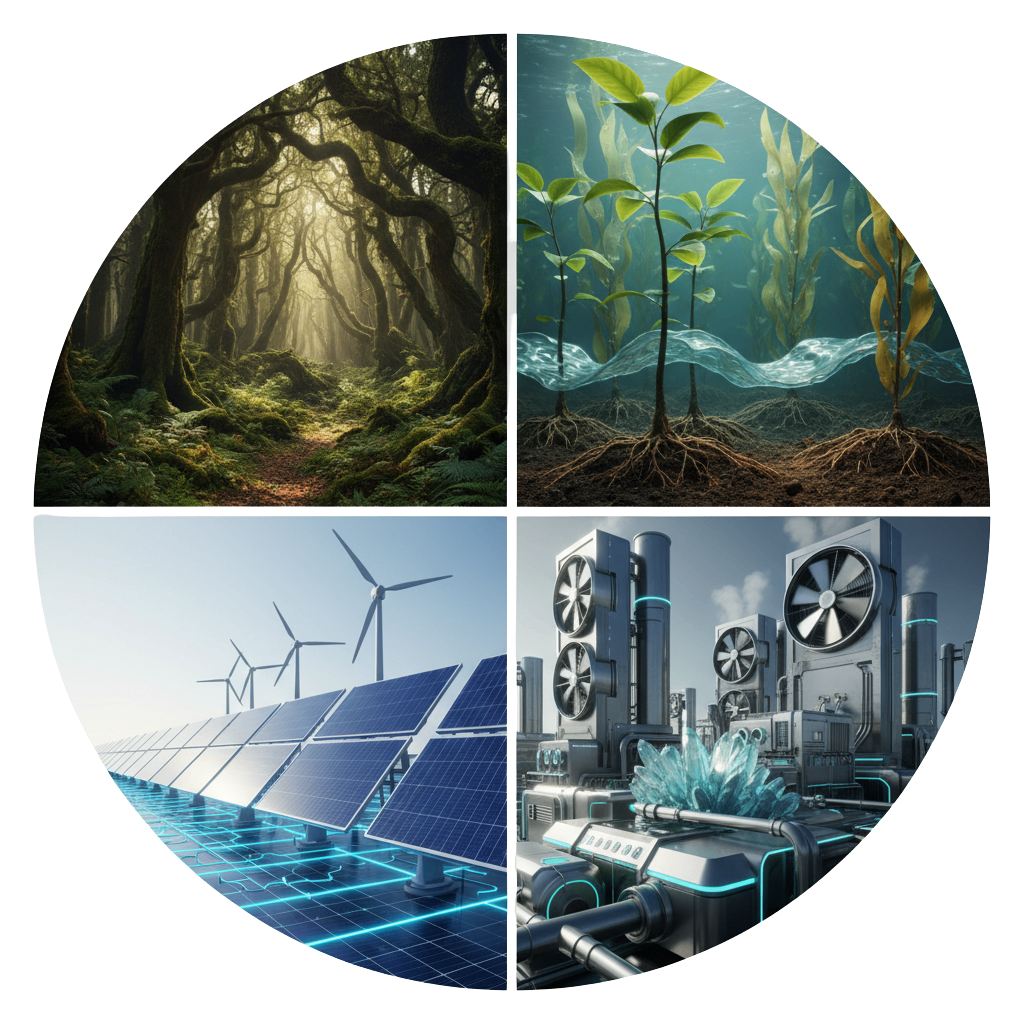
The project types below represent key categories commonly seen across global carbon markets.
.png)
| Project Type | What the Project Delivers |
|---|---|
Clean Energy | Avoids CO₂ emissions by replacing fossil-fuel–based electricity with renewable power. |
Energy Efficiency | Cuts emissions by using less energy to deliver the same output or service. |
Fuel Switching | Avoids emissions by shifting from high-carbon fuels to cleaner alternatives. |
Clean Cooking | Prevents household emissions by replacing traditional biomass or fossil fuels with clean cooking solutions. |
Waste Management | Avoids methane emissions through improved waste treatment, disposal, and recovery. |
Improved Forest Management (IFM) | Avoids emissions by preventing forest degradation and loss of existing carbon stocks. |
Methane Capture | Delivers high-impact reductions by capturing methane before it escapes into the atmosphere. |
Industrial Emission Reduction | Directly reduces emissions from carbon-intensive industrial processes. |
Afforestation / Reforestation (ARR) | Removes CO₂ from the atmosphere through long-term growth of new forest biomass. |
Improved Forest Management (IFM) | Removes CO₂ by increasing carbon storage in existing forests beyond business-as-usual levels. |
Blue Carbon (Mangroves, Wetlands) | Removes and stores carbon in coastal vegetation and underlying soils. |
Soil Carbon | Sequesters additional CO₂ in soils through improved land and agricultural practices. |
Biochar | Locks atmospheric carbon into a stable form, enabling long-duration CO₂ removal. |
Enhanced Rock Weathering (ERW) | Removes CO₂ by accelerating natural mineralisation processes. |
Direct Air Capture (DAC) | Removes CO₂ directly from the air with permanent geological storage. |
BECCS | Captures and permanently stores CO₂ from biomass or industrial CO₂ streams. |
At a basic level, carbon projects can be understood by what they do, avoid emissions or remove CO₂, and how they do it, through natural systems or technology. This framework helps simplify a complex carbon landscape.